Satellite-Based Environmental Impact Assessment of Maritime Shipping

The Satellite-Based Environmental Impact Assessment is an analytical framework designed for evaluating the impact of maritime shipping on marine and atmospheric quality across the Mediterranean Sea. It provides a scalable, data-driven alternative to localized in-situ monitoring campaigns, enabling basin-wide environmental screening from open-access satellite data. The framework integrates multi-source geospatial datasets, non-parametric statistical testing, and machine learning regression into a single workflow covering both large-scale impact assessment and high-resolution water quality estimation from hyperspectral imagery.
Key Features
- Multi-source geospatial dataset at 1 km resolution combining vessel route density, water quality, and atmospheric indicators
- Non-parametric statistical framework (Kruskal-Wallis + Dunn post-hoc) for robust impact assessment without normality assumptions
- Multi-scale correlation analysis at pixel, regional (EEZ/IHO), and basin-wide levels
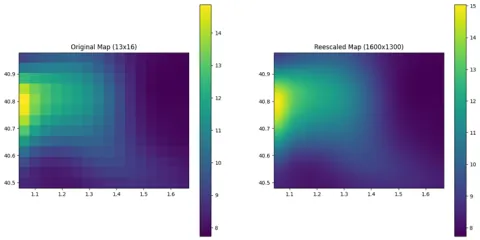
- High-resolution marine variable inference from PRISMA hyperspectral imagery (239 bands, ~30 m/pixel)Monitored Indicators
The framework covers the following environmental variables:
- Chlorophyll-a (Chl-a) — phytoplankton biomass proxy
- Absorption by gelbstoff and detrital material (ADG) — dissolved organic matter and non-algal particles
- Suspended Particulate Matter (SPM)
- Dissolved oxygen concentration (from PRISMA hyperspectral inference
- The system is applicable to the entire Mediterranean basin and compatible with coastal, open-sea, and port-approach environments.
Data Sources (open-access):
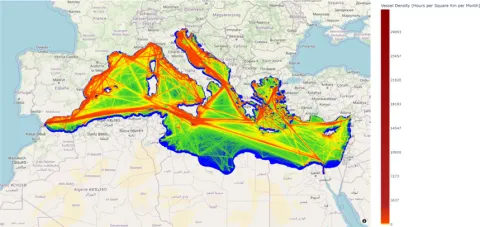
- EMSA route density maps (EMODnet Human Activities) for vessel traffic intensity
- CMEMS Bio-Geo-Chemical products for ADG, SPM, and dissolved oxygen
- PRISMA hyperspectral satellite imagery (ASI) for high-resolution spectral analysis
Methodology: Maritime traffic density is classified into three intensity levels (low, medium, high) using tertiles calculated over the 2022–2024 period. The Kruskal-Wallis test, complemented by Dunn post-hoc comparisons with Holm correction, is applied to assess whether the distributions of water quality indicators differ significantly between traffic classes. Temporal and spatial correlations (Pearson) are computed at multiple scales. For high-resolution inference, PRISMA hyperspectral images are spatially reconciled with CMEMS oceanographic products through spline, Lanczos, and nearest-neighbour interpolation. Multi-criterion spectral correlation analysis (Pearson, Spearman, Kendall) identifies the most informative spectral bands, and five regression model families are systematically evaluated for dissolved oxygen estimation.
Main Results: Statistically significant differences (p < 0.001) were found in both Chl-a and ADG distributions across all traffic classes and all years analysed. Atmospheric NO₂ emerged as the most direct indicator of shipping intensity (r = 0.83 at basin scale). ADG proved more sensitive to traffic pressure than Chl-a, which is dominated by seasonal and biological factors. Passenger and fishing vessels showed stronger environmental correlations than cargo ships and tankers. Lead (Pb) showed the clearest association with shipping among heavy metals, particularly in bottom sediments and biota. For PRISMA-based inference, the Neural Network trained on raw spectra achieved the best accuracy-generalisation balance (R² = 0.76, MSE = 8.78), while linear SVR demonstrated robust cross-scene generalisation (R² = 0.49) without overfitting. Key spectral regions were identified at 550–650 nm and 750–780 nm.
Validation and Use Cases: The statistical analysis covers the entire Mediterranean basin for the post-pandemic period 2022–2024 using publicly available satellite and in-situ data. Results have been published in a peer-reviewed journal. The PRISMA-based regression was validated on a held-out test set of approximately 7.3 million pixels from geographically distinct scenes, supporting its potential as a complementary remote sensing layer within the iMERMAID monitoring framework.
Target Users and Applications
- Environmental monitoring agencies
- Maritime traffic regulators and port authorities
- Marine policy makers and international organisations (IMO, EU)
- Remote sensing and Earth observation researchers
- Emergency response teams during pollution events
The framework is particularly suitable as a screening and decision-support tool for evaluating the environmental footprint of maritime traffic and for high-resolution water quality monitoring in areas where in-situ measurements are sparse.
Contacts
For technical information or collaboration opportunities, please contact:
- Organizations: ITCL / NTUU KPI
- Department / Lab: Computer Vision
- Email: [email protected]
- Website: https://itcl.es/